
For most Central Coast homes, steam cleaning (hot water extraction) is the better choice for a full clean, because it flushes out the grit and oily soil sitting at the base of the pile rather than just the top. Dry carpet cleaning, which is really low-moisture cleaning, dries much faster and earns its place as a freshen-up between deep cleans, in busy offices, and on carpets that shouldn’t get wet. The right call comes down to how dirty the carpet is, what it’s made of, and how soon you need to walk on it.
We should declare an interest. Hot water extraction is the method we use on most home carpets across the Central Coast, so you’d expect us to back it. We also run encapsulation machines, a low-moisture method, on commercial carpet, so we’ve got no reason to pretend dry cleaning is useless. It isn’t. It’s a different tool, and plenty of people end up paying for the wrong one.
What “dry” carpet cleaning actually means
Dry carpet cleaning isn’t completely dry. It’s a family of low-moisture methods that use far less water than steam cleaning, so the carpet is back in use quickly. The three you’re most likely to come across are these.
- Encapsulation. A cleaning solution is worked into the pile with a brush or rotary machine. As it dries, it crystallises around the soil, and your next few vacuums pick the crystals up.
- Dry compound. A damp, absorbent powder is brushed through the carpet to soak up soil, then vacuumed out.
- Bonnet cleaning. A spinning pad soaked in solution buffs the top of the pile. Carpet looks better fast, though the work happens mostly on the surface.
What they share is speed. What none of them do is rinse anything out. The soil is absorbed, crystallised or buffed, then left for the vacuum to collect.
What steam cleaning actually does
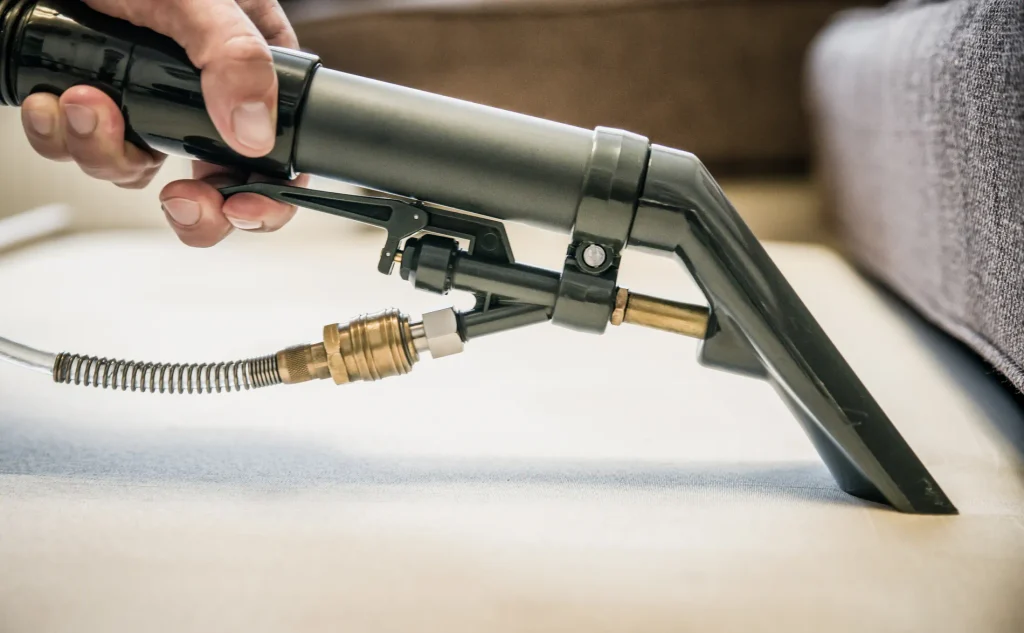
Steam cleaning doesn’t use steam. The proper name is hot water extraction: hot water and cleaning solution are pushed into the carpet under pressure, then sucked straight back out with the loosened dirt in it. The Carpet Institute of Australia describes it as the most common method for corrective deep cleaning, and lists low-moisture cleaning as an interim option for lifting surface soil with short drying times.
On a typical home job, ours runs in this order. A pre-spray matched to the carpet and the soiling goes down first, then Australian-made brush machines agitate the pile to loosen what’s stuck at the base of the fibres, then hot water extraction rinses it all out. Stubborn spots get a second go at the end. That rinse is the step low-moisture methods skip, and it’s why steam cleaning gets further on heavy soil, sticky residue and anything that has soaked into the backing.
The trade-off is water. Professionally steam-cleaned carpet usually needs 6 to 12 hours to dry, and can take up to a day in a cool, humid room with the windows shut.
Steam vs dry cleaning side by side
| Steam cleaning (hot water extraction) | Dry (low-moisture) cleaning | |
| How deep it cleans | Rinses through the whole pile to the base of the fibres | Mostly the top and middle of the pile |
| Drying time | Usually 6 to 12 hours, up to 24 in humid weather | Usually much quicker, often walkable within an hour or two |
| Heavy soil and traffic lanes | The better option | Improves the look, leaves embedded grit behind |
| Pet urine and odour | Can treat and flush the affected area | Can’t reach urine in the backing or underlay |
| Residue | Rinsed out during extraction | Relies on your vacuuming to remove what’s left |
| Best used for | A full clean every 12 to 18 months, and problem carpets | Maintenance between deep cleans, busy commercial floors |
When steam cleaning is the better call
Pick steam cleaning when the carpet needs fixing rather than freshening. That usually means one or more of these is true.
- It hasn’t had a proper clean in a year or more, or ever.
- There are dark walkways down the hallway or in front of the lounge.
- A dog or cat has had accidents. Urine soaks through to the backing and underlay, and a surface method can’t follow it down there. Our guide to getting dog urine out of carpet covers what to do in the meantime.
- Kids have been at it with milk, juice, vomit or mud.
- Someone in the house has allergies and you want dust and dander flushed out rather than moved around.
- You’re moving out and the carpet has to hold up at the final inspection.
A carpet with years of soil in it will look brighter after a low-moisture clean. The grit still sitting at the base keeps wearing the fibre and dulling the colour, though, and the carpet slides back faster than you’d hope.
When dry cleaning is the better call
Low-moisture cleaning is the smarter choice in a handful of situations, and we’d tell you so.
- Offices and shops that can’t close. Carpet you can walk on within the hour means no lost trading day. It’s why encapsulation is part of our kit for commercial carpet cleaning.
- A light lift between deep cleans. A spare room or a lightly used lounge that just looks flat before visitors arrive.
- When the room has to be back in use the same day. On a dirty carpet, a quick-drying clean buys you time rather than a fix, so plan the deep clean for later.
- Natural fibres that don’t like water. Sisal, seagrass, coir and jute can shrink, brown or water-mark when they get wet, so they generally need low-moisture methods. Check the manufacturer’s care guide first.
Rugs are a separate story. A wool, Persian or handmade rug is better washed through properly than cleaned where it lies, which is why ours go to our Morisset rug-washing facility, with free pickup and delivery across the Central Coast.
How each method goes wrong
With dry cleaning, the risk is build-up. Because nothing gets rinsed out, low-moisture clean after low-moisture clean can leave solution and soil collecting in the pile, and the carpet starts re-soiling faster. Consumer group CHOICE lands in the same place in its guide to carpet cleaning options: dry cleaning suits maintenance, and steam cleaning is the one for a full clean.
With steam cleaning, the risk is over-wetting. Too much water and not enough extraction leaves carpet damp for a day or more, and that’s when musty smells and stains wicking back up from the backing start to show. Strong extraction and good airflow afterwards are what keep drying time sensible. It’s also the main reason carpet makers are wary of DIY hire machines.
Does the method matter for your carpet warranty?
It can. Most carpet warranties depend on the carpet being looked after the way the manufacturer specifies, and the Carpet Institute recommends checking that paperwork before you choose a method. If you still have the care guide from when the carpet went in, have a look before you book. It matters most for wool, which needs gentler chemistry and slower drying than nylon or polyester.
Three questions that settle it
- When was it last properly cleaned? If you can’t remember, it needs a steam clean. If it was within the past year and it just looks a bit flat, a low-moisture clean may be all it needs.
- Is the problem on the carpet or in it? Spills that have soaked in, pet accidents and smells point to steam. Light dust and a tired look could go either way.
- How long can you stay off it? If you can keep off it for most of a day, steam cleaning fits easily around you. If the room has to be back in use within an hour or two, low-moisture is the practical option for now.
Still torn? Tell us which room it is, what lives on it (kids, a dog, a red wine habit), and roughly when it was last done, and Steve or Clint will tell you which method they’d use on it and why. Get in touch with Steamy Wonder Cleaning today.